








By Narayan Prasad Mishra
When we call the writer, the pictures come to our minds of the people who write about their study, research, knowledge, and experience. They write to share their knowledge with others. The primary purpose of writing is to give your ability to others. If we try to classify the writers, they could be mainly classified in two different areas – literary writers (poets, novelists, essayists) and technical and vocational writers (creators of technical writings – medicine, engineering, agriculture, economics politics).
The writers have an essential role in making the world what we see today. Knowledge is the source of all human creation – aeroplanes, ships, Cruz, motor cars, etc. The contribution and innovation of technical writers are visibly seen. But the gift and production of a literary writer would not be so clear to see it. That is why some people think they are unproductive. But in a real sense, that is not so. If the technical writers create physical things, literary writers create a healthy society with a high quality of ethical, moral rich human beings. So the literary writers also are highly read and respected throughout the world.
We are not skimpy with the literary writers in our country. We had highly read, liked, loved, and respected literary giants – poet the laurate Kavishiromani Lekhnath Poudel. Playwright Emperor Balkrishna Sama and great poet Laxmi Prasad Devkota. We have even now hundreds of literary figures in the country. They are doing their best, creating valuable literary works – poems, novels, stories, essays, and dramas, But our literary writers have been facing varieties of problems – publishing, marketing, publicity, etc. Their readers are limited. They have difficulty in getting the works published. They cannot sell the books as they should be because of the lack of reading habits in society. They are not read and known in other countries due to the lack of translation works in international languages. So, they have no chance of getting international awards like the Nobel Prize. If any case is filed against them for their writings, they are again in a complex problem. My beloved wife, Shanti Mishra, and I knew these problems very well. Because we both were writers and we had very close and cordial relations with Nepali writers being the chief librarians of the Tribhuvan University Central Library. Everybody could easily understand the relationship between books, libraries, and librarians. They are one in three. We always wished to do something for this cause but we could not do anything more than thinking.
As we have many associations and organizations in different fields, we also had a Nepali literary association. We all know the meaning and purpose of any association would be the organization of the group of people established to work for the group’s expected interest, welfare, and the profession to which it belongs. In practice, with some exceptions, we do not see it. Especially in developing countries, the cleverest few on the executive committee would enjoy some benefits – participating in seminars and conferences in foreign countries, observation tours, travel, study under scholarships, earning through some projects, rather than working for the professional organization’s common interests. Everywhere people are self-centered, as we see in the political parties in Nepal. The leaders and the followers are to be pure volunteers, but all have a different motive not to serve but to gain. So, I always hesitated to join the associations, INGOs or NGOs.
When you needed to contact, inquire, or know anything about the unknown country and anything about any subject, you would correspond to the library. That is an established international fact. We had varieties of inquiries in the library about anything – literature, politics, social, culture, science, arts, etc. We helped the people being to the jurisdiction of the country. We had a request from the Carroll Foundation, Australia, for getting translated in Nepali of Alice’s Adventures in Wonderland, the famous children’s book, if it had not been in the Nepali language. Shanti got it solved by Prof. Chudamani Bandhu and helped the Foundation. Someone from the foreign country wanted information about “Shaligram”, the holy stone regarded as Hindu God Vishnu. We helped the person accordingly. Some American scholars wished to work with a reputed Sanskrit scholar who knew the English language. We helped him consequently. We discussed and debated the necessity of the literary organization linked with PEN International, the writers’ international association when the question came about. The name PEN stands for “Poets, Playwrights, Editors, Essayists, Novelists. It is a non-political organization established to promote literature, friendship, and intellectual cooperation among writers defending the freedom of expression. Shanti wished the nation’s literary association unbiased and entirely devoted to the academic cause with all the country’s well-known writers. I always discouraged her not to involve and wish about an unbiased and selfless organization in our country. I always thought that it would be almost impossible to have. But she did not forget her want to.
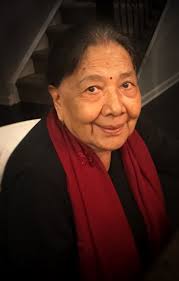
Shanti Mishra, founding chairman of the PEN International Nepal Chapter
Greta Rana, English writer, wife of Madhukar Shumsher Rana, and Shanti became good friends after we came to know her. Madhukar was with CEDA (Center for Economic Development and Administration) a research organization headed by Pashupati Shumshet Rana situated at our library building. CEDA building was under construction. We were friends of the same organization, the University. I happily remember the day we attended the grand dinner party organized by them for their son’s rice feeding ceremony in their residence with all the CEDA staff.
Greta came to the library from time to time. Shanti and Greta started talking and discussing establishing PEN International Nepal. Well-known novelist Dhruva Chandra Gautam was a professor in the Department of Nepali Literature at T.U. We knew him very well. Shanti introduced him to Greta for this purpose. I did not show any interest and stayed away. They decided to proceed with this work and drafted the constitution. Prof. Gautam, the Madan Puraskar winner well-known writer, took the responsibility to make and invite writers to be the members. PEN International Nepal got formed with Shanti Mishra the founder president, Dr Dhruba Chandra Gautam the vice president, and Greta Rana, the Secretary-General, and it was unanimously elected to membership of PEN International at the Congress held in Seoul on August 31 and September 1 in 1988.
Shanti was happy for fulfilling her desire. She thought she could start an organization that would not inherit the selfish motive like any other organization that her association would be worthy of appreciation by all. She cherished working for the betterment of all, not only for the executive few. She conducted a lot of programmes. The association was lively then. Krishna Prasad Bhattarai, then Prime Minister, inaugurated the first annual programme with the literature festival and short story shield awards organized by this association at the Hotel Annapurna on April 27, 1991.
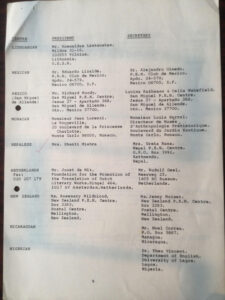
Nepal in PEN International
I well remember when she was in the International Women’s Year Committee, 1975, Nepal, as its member secretary, she was entirely devoted to the cause of the women and kept busy at work. Queen Aishwarya was the patron of this committee. Shanti never showed interest in going to seminars and conferences to enjoy. She did not attend any international meetings and went abroad though she had received many invitations. Instead, she gave a chance to other members for this purpose. Being the president of this literary association, she maintained her same attitude and worked in the same manner. During her period, there were some invitations. But she did not go anywhere. She gave chances to Gautam the Vice President, Mrs Rana the General Secretary, and other members. They went to Canada and other countries. She exhibited her ideal in action. She wrote about establishing this association in more detail in her book” Voice of Truth: The Challenges and Struggles of a Nepalese Woman, page 375-397. The association admired her work and ideal. After her term of presidency, the association decided to print the name of the three founding members – Shanti Mishra President, Dr Dhruba Chandra Gautam Vice President, and Greta Rana, General Secretary on the letterhead of the association to commemorate the founding members. That was the time when Dr Gautam and Greta Rana were the president and the general secretary respectively.
I, too, became a member of this organization after Shanti’s presidency as she wished though I did not want to. I did not have enjoyable experiences in any association I got involved in. After Greta Rana, Prof Ram Kumar Pandey the satire and humor writer, became the president. Prakash A Raj was the general secretary at that time. He circulated a letter asking all members to submit the one-page biodata to publish a list of members with a brief biography. There was no format and no requirement to meet for this purpose. Only the condition should not be more than one page. We submitted the biodatas as requested, which were not even three fourth pages. To our surprise, we saw our biodata brought out, not how we gave editing, cutting the information at the person’s whims. We were so surprised to see the ugly mind of the editor. I voiced it. The association we’re working as any other association of the country. They even omitted three founder members’ names, including Shanti Mishra, Founder President, from the letterhead against the previous organizational decision.
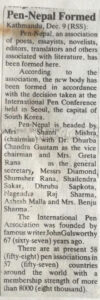
News published in The Rising Nepal
We were astonished. They could not show even this much goodwill for the service done to the literary world. To whom to talk and to whom to show our concern we did not know. Gradually we pulled out our leg from this association. We saw most of the members involved in establishing this association disappeared from this center due to the unhealthy atmosphere of groupism, not suitable for this noble association. I remember once when the then journalist association went in a wrong way against journalism’s noble ethics, Gopal Das Shrestha, a well-known journalist of the country and the chief editor of The Commoner, English daily wrote an article in Samaj, the Nepali daily newspaper. He wrote that the noble journalists ran away from the journalist association. Shanti’s hope of seeing the exemplary association attached to the ideals written in the charter disappeared in her life. The association demands honesty, sincerity, truthfulness, kindness from all. The writers, especially the members of this organization, are supposed to speak and write against others’ injustice to arouse society. They need to speak and write for all kinds of justice. How can they not speak and write to give a gesture of goodwill to their founding president? Among them, someone may dislike her or her being the founder president. Shanti Mishra, the English translator of “Rupamati” Nepali novel; novelist of “A Widow’s Gift”, English fiction; and writer of several other books, was the founding president of that association. That is well recorded not only in Nepal but in the head office of PEN International, London. It cannot be omitted or erased. I hope someone will develop this association someday as an ideal association as my Shanti wished and establish her name at least on the letterhead as history decided.

Login to add a comment